I sign my canvases with two letters and an exclamation mark: NL! People sometimes ask me why the exclamation mark. I tell them it’s a way of not ending the sentence on silence. To me, a canvas is never a conclusion. It’s an exclamation: surprise, joy, sometimes anger, something that needs to be said out loud. I’ve been painting since 1993, and if I had to sum up thirty years in the studio in a single line, it would be this one: I paint so that things don’t go unsaid.
Painting so as not to stay silent
In 2021, I painted a woman in profile whose mouth is sewn shut. She is sinking into a gray sea, and the canvas is called Chuuut (“Shhh”). That same year, I painted blindfolded faces rising toward a leaden sky, surrounded by other faces, anonymous, more and more of them. The series is called Ni Una Menos, “not one less,” after the movement against femicide that began in Argentina.
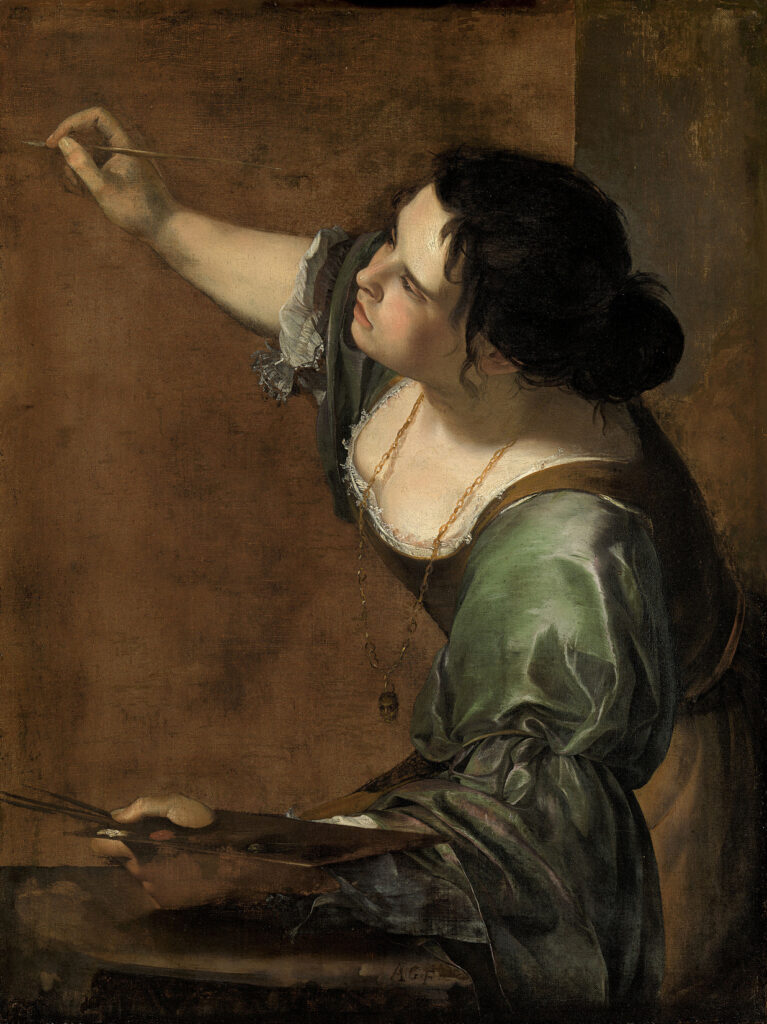

I didn’t paint the blood or the blows. I don’t believe art needs to replay violence in order to denounce it. I painted what violence produces: silence, erasure, the crowd of women whose names are no longer spoken. I often think of Artemisia Gentileschi, who painted in the 17th century, in a world where a woman painter was an anomaly. She went through a trial, shame and suspicion, and she kept painting: strong women, women who act. She even portrayed herself as the allegory of Painting, brush in hand, absorbed in her work, unconcerned with being looked at. It is one of the images I carry with me.
To paint is to refuse to let silence have the last word. A canvas hanging in a living room, a hallway or an office keeps speaking when no one is listening anymore. It comes back every morning. It asks its question gently, without slogans, every single day. I believe in that persistence more than in grand speeches.
What color can repair
People often tell me my painting is joyful. It’s true, and it isn’t lightness. For me, color is a decision. In Résilience, a woman emerges from the storm: behind her, gray; ahead of her, the soft green and yellow of spring. I didn’t paint the storm for its own sake. I painted it so you can see that there is a way out.
I believe art heals. Not like medicine, but like a presence. A 2019 report by the World Health Organization brought together thousands of studies on the links between the arts and health: looking at art, making it and sharing it affects our mood, our isolation, the way we go through illness and grief. I didn’t need a study to know it, but it reassures me: what I feel in the studio is not a private illusion.
When I paint, the world steps back, just far enough for us to look at it again. Like everyone, I have been through difficult years. Painting was the place where I could still choose: a color, a shape, a line. To choose, when everything else is slipping away, is already to begin to mend. And I believe a work passes something of that gesture on to whoever looks at it. It doesn’t say “everything is fine.” It says: “there is still color.”
Giving women back their own gaze
I trained as a fashion designer, then worked for years in luxury ready-to-wear. There I learned to look at women’s bodies with precision, and I also saw how much those bodies were looked at, measured, judged and sold. When I came back to the studio in 2011, I came back with a subject: women. And with a question: who is looking at whom?

Les Petites Nanas were born from that question. They are pin-ups, yes, the most worn-out figure in popular culture, the girl on calendars and soldiers’ lockers. I took them as they were, with their stockings, their heels, their poses, and I gave them back the upper hand. In Les Vanités, six women face a skull. Tradition cast woman as the vain creature death comes to punish. Mine sit on the skull, stretch out on it for a nap, play with it. In Le Jeu (The Game), a blonde in black gloves plays with death, and wins.
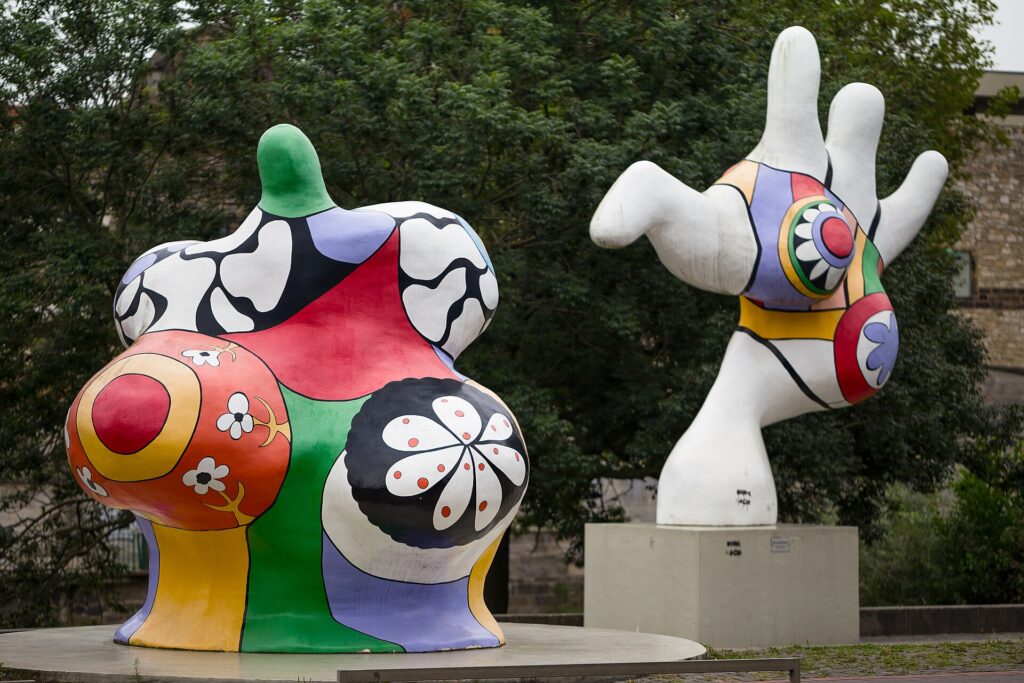
I owe a great deal to Niki de Saint Phalle’s Nanas, those huge women dancing through cities, round, colorful, sovereign. They taught me that you can be a feminist without giving up joy, femininity or humor. That’s what I try to do. I don’t paint women as victims. I paint women taking back control of their image, even when they are tied up, even when they have been turned into musical instruments. The cliché is there, but they are the ones playing with it.
Hiding in order to show
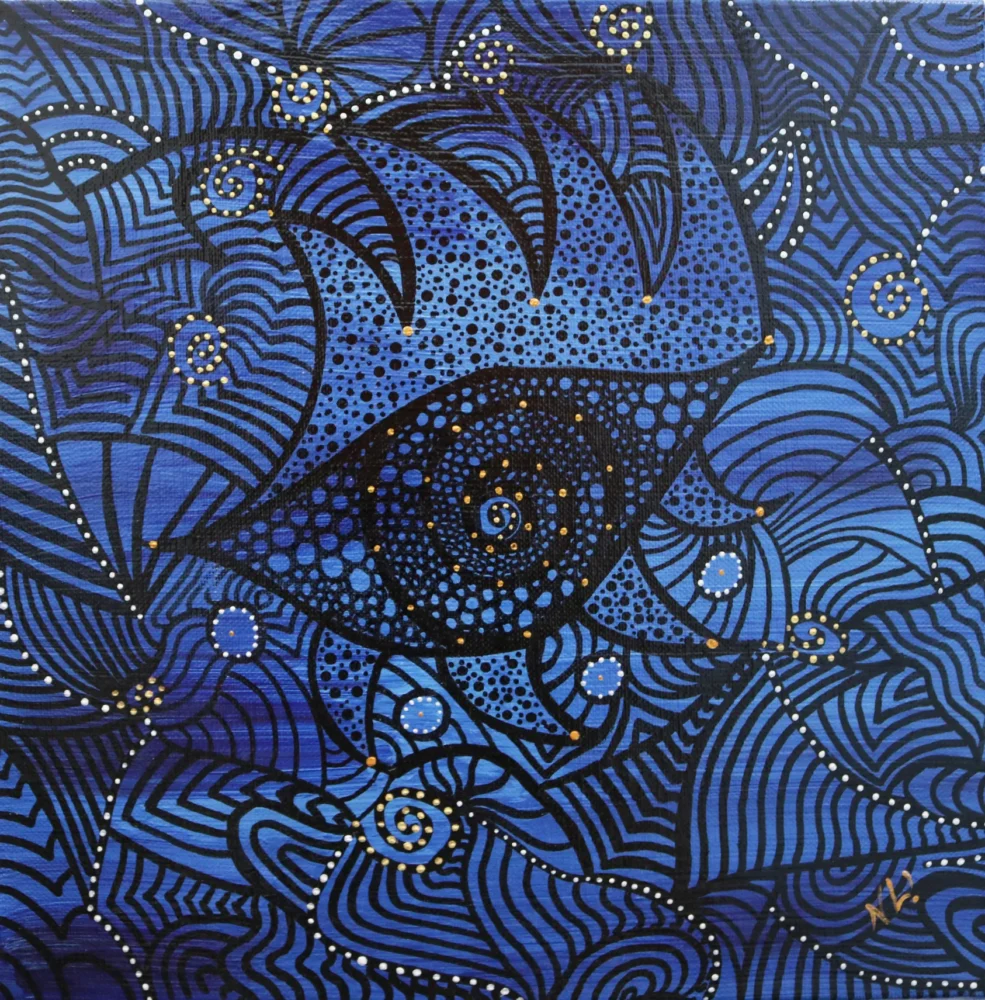
Since 2016, part of my work has turned toward abstraction. In Effet de Vagues, the canvas is at first nothing but movement: waves, spirals, bursts of color, painted with my fingers, cut out, outlined in black. And then, if you take the time, a figure appears. An eye, in Look 2. An ear, in Lesson. A heart-shaped mouth, in Enjoy. A face and its reflection, in Camouflage. A silhouette melting into a burst of color, in La Femme Caméléon.
This game of hide-and-seek is not a whim. It asks the viewer to really look. We live surrounded by images that scroll past and vanish; we see them without looking at them. A work that doesn’t give itself away at once forces us to slow down. It sets up a meeting. I believe that relearning how to look slowly is one of the most useful things art can offer our time.
And what hides in my waves says something about women. How many have had to blend into the background in order to exist, stay quiet in order to be tolerated, camouflage themselves in order to survive? In my work, the hidden figure is never erased. It is waiting to be seen.
Laughter, a courtesy and a weapon
You might think humor weakens a message. I think the opposite. In Saligia, I painted the seven deadly sins as seven pin-ups: pride sits enthroned on the globe, greed guards her loot like a bandit, gluttony devours a chocolate religieuse (in French, both a pastry and a nun), and the double meaning is fully intended. For centuries, the vices were handed to women so that women could be blamed. My sinners don’t repent. They’re having fun, and viewers catch themselves laughing along.
Laughter disarms. It lets you say serious things without shutting the door. My titles are part of the game: Chat’terton, Jane Bondage, Elliot, Le Garde des Seaux. A pun is a small key: it opens the work to someone who wouldn’t have felt invited by a speech. I want my paintings to be welcoming. I want a child to see a story in them, an adult a wink, and everyone to be able to come back and find something new.
What art can change: seven proposals
I’m not a politician. I’m a painter. But I believe art has a place to claim in the way we live together, and I want to defend it with simple proposals. Some already exist, here or elsewhere; we would only need to extend them.
- An original artwork in every school. Not a poster, a real work, lent by a living artist, changing every year. Growing up next to a painting teaches you that an image can be looked at for a long time.
- Prescribe art. In Montreal, doctors have been able to prescribe museum visits since 2018. The World Health Organization’s 2019 report points the same way. Let’s make art part of care, in hospitals, nursing homes and rehabilitation centers.
- Extend the “1 percent for art.” Since 1951, France has required part of the construction budget of public buildings to go to a work of art, and many American cities have similar percent-for-art programs. Why not apartment buildings, offices, train stations?
- Replace advertising with art. Starting in 2015, the French city of Grenoble removed a large share of the billboards from its streets. Imagine those walls handed over to artists, and passersby meeting a work of art instead of an order to consume. That is exactly what pop art has been questioning for sixty years, and what my cheeky Mickeys keep asking.
- Make real room for women artists. Women remain a minority in public collections and on the art market. Exhibiting, buying and passing on their work on equal terms means repairing an art history that was only half written.
- Open the studios. Open-studio days exist in many cities. Let’s have more of them: watching a work come to life changes the way you look at it, and brings the people who make art closer to the people who look at it.
- Live with art instead of visiting it. Art lending libraries lend works the way libraries lend books. Companies can rent works for their teams. A work you see every day acts more deeply than one you saw once.
None of these ideas is expensive compared with what it gives back: connection, attention, a little beauty in places where nobody expects it.
Childhood, Africa, music: what connects us
I also paint for the people I love. Portrait de Famille (Family Portrait), in The Family Stone series, shows my whole tribe at the window, comic-book style. The people close to me become a pirate, a beach bandit, a shark rider. These paintings are scrapbooks, and they say something simple: childhood is a territory we should never quite leave.
With Effet de Wax, I wanted to celebrate other bonds: the ones that link Africa, its diaspora and the world. In Wax Upon A Time, a profile with a head wrap, an afro pinned with a flower, stands out against raw wood, among wax-print patterns painted dot by dot. Wax print is a fabric that crossed three continents before becoming an emblem. It says that an identity is never pure, that it is built from borrowings, encounters and reinventions. I think that is good news for our society.
Music, finally, runs through all my work: reggae, soul, jazz, 1960s rock. It is proof that an emotion can travel without translation. I’d like my paintings to do the same.
A work of art, a conversation that lasts
I paint one-of-a-kind pieces. Every flat area of color is painted, cut out, mounted and outlined by hand. I don’t say this for the beauty of the gesture, but because I believe an original work carries something a printed image cannot: the time spent, the hesitations, the hand. When someone lives with one of my paintings, they live with that time.
That’s also why I insist on talking myself with the people who are interested in my work. A work is not an object you deliver; it is a conversation that begins. I want to know where it will live, who will look at it in the morning, what it will awaken. Nothing touches me more than learning, sometimes years later, what a painting has become for someone.
So, why do I paint?
I paint because silence is not an answer. Because color is a way of saying that life wins. Because women deserve to see themselves as they see themselves, not as they have been shown. Because humor opens doors that anger closes. Because a society that lives with art looks more slowly, listens better, and remembers what connects it.
And finally, I paint because a painting hanging somewhere keeps saying what I can’t say to each person myself. It’s my exclamation mark. It’s at the bottom of every canvas, waiting for a reply.
Works by Nathalie Latil


See all the works · Discover the collections · Meet the artist